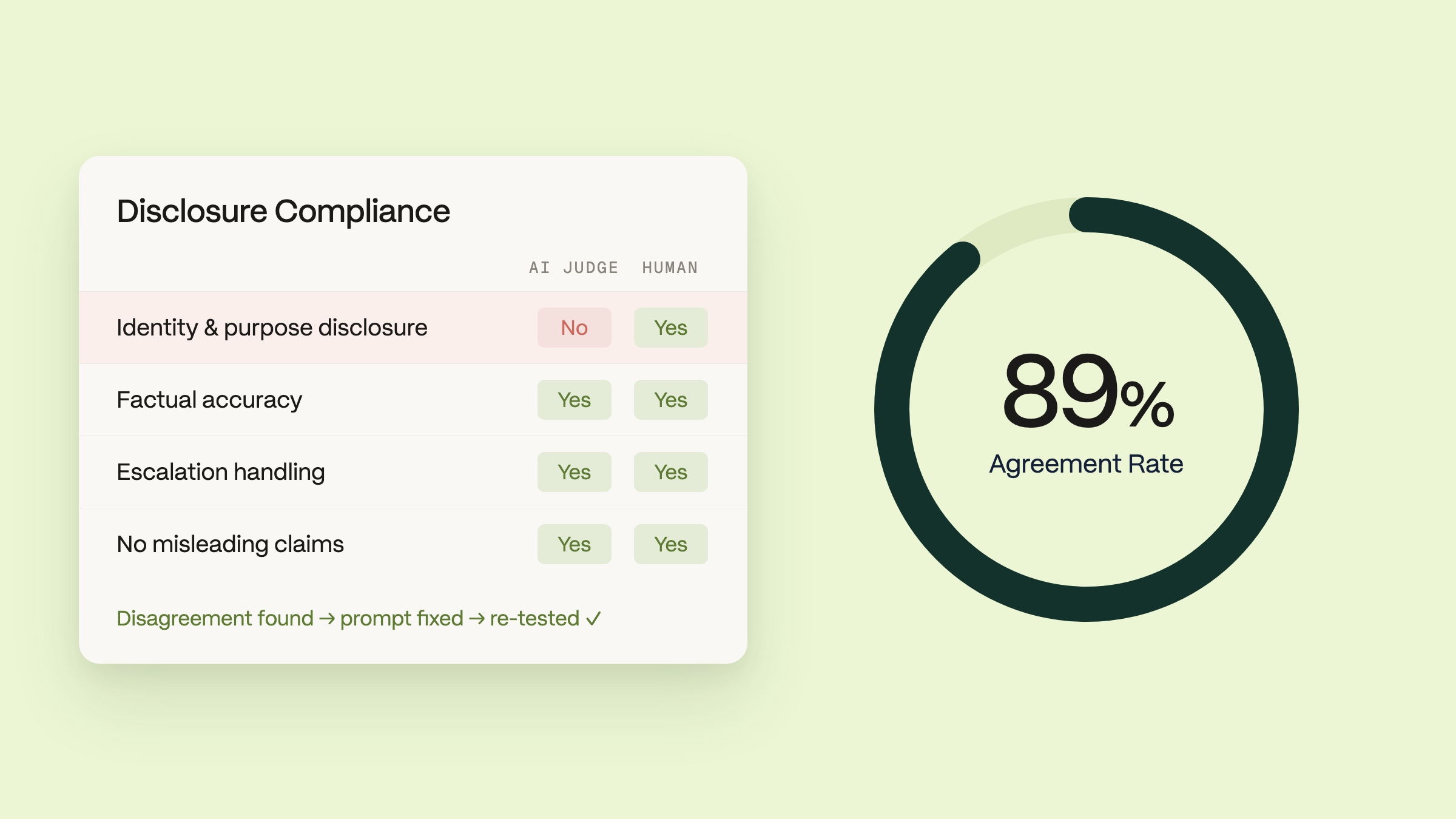
How to Create AI Judge Metrics You Can Trust
How to use human review in Coval to calibrate your LLM-as-a-judge metrics: label conversations, check agreement, read disagreements, fix the prompt, and re-test.


Coval's observations on developing and shipping AI voice agents



How to use human review in Coval to calibrate your LLM-as-a-judge metrics: label conversations, check agreement, read disagreements, fix the prompt, and re-test.

Coval and Hamming both test voice and chat agents. Coval is the more established platform, built for regulated industries that can't afford a failed call, with human review at its core.

Voice AI latency is the silence between a caller's last word and the agent's first sound. Here is the target, where the time goes, and how to measure the tail.

A cascaded system lets you check every reply before the caller hears it; speech-to-speech wins on conversational feel. The evidence on speed, accuracy, and cost, and how to test both.

A voice AI testing framework decides which simulated calls your agent must pass and what fails a release. Here are our three layers, their pass rules, and how fixed failures move between them.

PolyAI's Dialog-RSN-1 leads our speech-to-speech benchmark and Gemini 2.5 Flash is the fastest raw model on our LLM board. The full rankings, the catch on each pick, and how to test them on your calls.

Conversational AI holds a back-and-forth conversation by text or voice and acts on what people ask. Here's how it works, where voice gets hard, and how to judge one.

Voice AI observability captures every production call and judges whether the agent did its job. Here's what it captures, what to measure, and how failures become tests.

Hamming and Cekura run the same voice agent testing loop. They differ in how you buy them and how they check their AI judge. Here's how.

A convincing demo is only a start. Test the calls that must go right, check automated grades against people, and turn confirmed failures into lasting coverage.