
GPT Realtime vs Gemini Live in 2026: Which Holds Up on Noisy Calls?


We ran OpenAI and Google's speech-to-speech models through the same calls in five audio conditions. Gemini answers faster; GPT-Live-1 keeps following instructions when the line gets bad.
OpenAI and Google both sell speech-to-speech models for voice agents: one model that hears the caller and answers out loud, with no separate transcription or text-to-speech step. OpenAI now has two, GPT Realtime 2 on its Realtime API and the newer GPT-Live-1, while Google is replacing Gemini 3.1 Flash Live with Gemini 3.8 Live. All four sound quick in a demo, with a clear voice in a quiet room. Real callers phone in from busy offices, desk speakerphones, and weak cell signals, and that’s where the GPT Realtime vs Gemini Live choice gets decided.
Quick answer: Gemini 3.8 Live is the faster pick: in every audio condition but the worst, it starts replying in 813 to 1,025 ms, against 1.4 to 1.8 seconds for OpenAI’s two models. Once there’s background noise, it also follows more of its instructions than GPT Realtime 2, which falls from 92% on clean calls to 62% when the caller is far from the phone in an echoey room. If your flow has to stay on script with noisy callers, choose OpenAI’s GPT-Live-1: it follows 92–93% of its instructions in every condition we test, against 84–88% for Gemini 3.8 Live, though it replies more slowly on most calls. (30-day averages on our speech-to-speech benchmark, as of November 4, 2026.)
Our take: a test on clean audio can crown the wrong model, so test on the audio your callers actually have. Below are the current versions and prices, how we tested, what we found for speed and instruction-following across five audio conditions, what those averages hide, which model to pick, and how to run the same test on your own agent.
OpenAI and Google each have two live speech models
Both families have new models, so start with which versions are current. As of publication, OpenAI’s lineup starts with GPT Realtime 2, its “most capable realtime voice model”, which runs on the Realtime API as gpt-realtime-2. gpt-realtime-2.1 updates it “with improved alphanumeric recognition” at the same price. gpt-realtime-2.1 is also OpenAI’s named replacement for the 2025 gpt-realtime, which shuts down on January 20, 2027. GPT-Live-1 works differently: it runs on a separate Live endpoint, keeps listening while it talks, and hands lookups and tool calls to a backend agent while it carries the conversation.
On Google’s side, Gemini 3.1 Flash Live is now a “legacy preview” that shuts down on November 17, 2026. Google names Gemini 3.8 Live, stable since September 15, 2026, as its replacement.
Here are the four models we compare, with list prices from OpenAI and Google as of November 4, 2026:
| Model | Where it runs | Status | List price |
|---|---|---|---|
| GPT Realtime 2 | OpenAI Realtime API | No shutdown announced; 2.1 update available | $32 in, $64 out per 1M audio tokens |
| GPT-Live-1 | OpenAI Live endpoint, with a backend model for tools | No shutdown announced | $0.05/min, billed per second, plus backend model and tool usage |
| Gemini 3.1 Flash Live (Preview) | Gemini Live API | Legacy preview; shuts down Nov 17, 2026 | $3 in, $12 out per 1M audio tokens (about $0.005/min in, $0.018/min out) |
| Gemini 3.8 Live | Gemini Live API | Stable since Sept 15, 2026 | $3 in, $12 out per 1M audio tokens (about $0.005/min in, $0.018/min out) |
On list price, Gemini 3.8 Live is the cheapest of the three current models by a wide margin. For cost per completed task, and for whether speech-to-speech is the right architecture at all, see our speech-to-speech vs cascaded comparison, and our guide to voice AI models for how the wider field ranks.
How we tested: the same calls in five audio conditions
Our speech-to-speech benchmark runs each model through full simulated phone calls, and every model gets the same fixed inputs. Each set of calls runs with five callers, as described in our benchmark’s persona file:
- Clean: a clear voice, with no background noise, degradation, or interruptions.
- Office noise: the same caller with busy-office chatter and keyboard noise behind them.
- Speakerphone: office noise plus a desk phone on speaker, so the voice sounds hollow and distant.
- Poor cell: office noise plus a weak cell signal that drops about one word in twenty.
- Far speakerphone: office noise plus a quiet caller far from the mic in an echoey room.
Voice-to-voice latency is the pause between the caller finishing a turn and the model’s reply starting, timed from the call recording rather than the provider’s own events. Instruction adherence is the share of the call’s requirements the model satisfied, from 0 to 100%. We time replies on one set of calls and grade instructions on another (a bank scenario), so read each table on its own.
Gemini answers faster on all but the worst audio
Gemini 3.8 Live replies sooner than both OpenAI models in four of the five conditions. The table shows 30-day average voice-to-voice latency on our first set of calls, as of November 4, 2026 (lower is better, 36 to 95 calls per cell). Each caller links to its dataset page, where the four noisy callers appear as low, medium, hard, and extra hard difficulty.
| Caller | GPT Realtime 2 | GPT-Live-1 | Gemini 3.1 Flash Live | Gemini 3.8 Live |
|---|---|---|---|---|
| Clean | 1,523 ms | 1,755 ms | 1,012 ms | 912 ms |
| Office noise | 1,629 ms | 1,393 ms | 950 ms | 813 ms |
| Speakerphone | 1,743 ms | 1,366 ms | 961 ms | 878 ms |
| Poor cell | 1,755 ms | 1,387 ms | 910 ms | 1,025 ms |
| Far speakerphone | 1,573 ms | 1,279 ms | 1,375 ms | 1,653 ms |
On clean, office-noise, and speakerphone calls, Gemini 3.8 Live starts talking in under a second, the fastest of the four. On poor-cell calls its predecessor edges it, 910 ms to 1,025 ms.
The far-speakerphone caller flips the order. Gemini 3.8 Live slows to 1,653 ms, about double its office-noise time and the slowest of the eight models we run on that dataset, while GPT-Live-1 (1,279 ms) and GPT Realtime 2 (1,573 ms) both answer sooner. GPT-Live-1 runs the other way from the rest: its slowest average comes on clean calls, where it’s last of the four, and with any background noise it stays between 1,279 and 1,393 ms.
GPT-Live-1 keeps following instructions as the audio worsens, and GPT Realtime 2 doesn’t
Speed is only half of it. On instructions, OpenAI’s two models part ways. This table shows 30-day average instruction adherence on our bank calls, as of November 4, 2026 (higher is better, 80 to 274 calls per cell):
| Caller | GPT Realtime 2 | GPT-Live-1 | Gemini 3.1 Flash Live | Gemini 3.8 Live |
|---|---|---|---|---|
| Clean | 92% | 93% | 95% | 85% |
| Office noise | 80% | 92% | 96% | 88% |
| Speakerphone | 73% | 93% | 95% | 87% |
| Poor cell | 69% | 92% | 91% | 84% |
| Far speakerphone | 62% | 92% | 93% | 84% |
On clean calls GPT Realtime 2 follows 92% of its instructions, well ahead of Gemini 3.8 Live’s 85%. Add office noise and GPT Realtime 2 falls to 80%, and by the far-speakerphone caller it’s down to 62%, missing more than a third of what it was told. GPT-Live-1 barely moves: 92 to 93% in every condition, and the top score of the four on poor-cell calls. Gemini 3.8 Live holds steady too, at 84 to 88%, but four to eight points below GPT-Live-1 throughout.
Put GPT Realtime 2 against Gemini 3.1 Flash Live and the older Gemini wins in every condition. It scores highest of the four in four of the five conditions, but Google is retiring it.
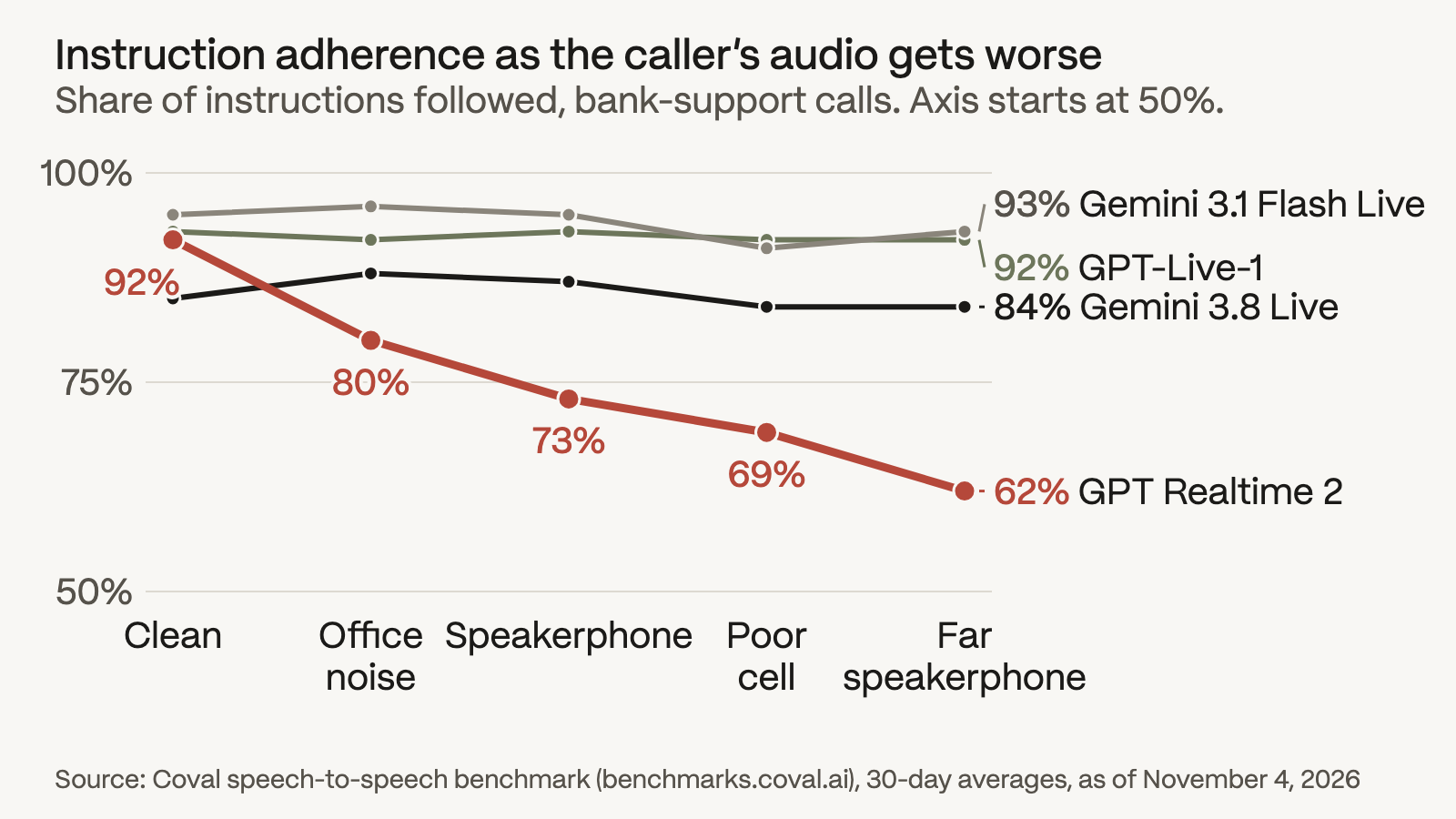
Instruction adherence on our bank calls as the caller’s audio gets worse. 30-day averages from benchmarks.coval.ai, as of November 4, 2026.
What the averages hide: slow replies and version swaps
An average can look healthy while some replies drag, and callers hear every reply, not the average. Our speech-to-speech board also reports p95 voice-to-voice latency, the time that 95% of replies beat and one in twenty doesn’t, as a separate measurement from the 30-day tables above. Its newest data, from November 3, 2026, puts GPT-Live-1’s p95 at 2,390 ms, the slowest of the four, so on a 20-turn call expect about one reply of 2.4 seconds or more.
Upgrades move the numbers too. Going from Gemini 3.1 Flash Live to 3.8 Live takes more than a new model name, and Google’s migration notes list four behavior changes. You can no longer set a thinking level, because reasoning is built in. Affective dialog, which adapts the reply’s tone to how the caller sounds, is gone. Proactive audio, which lets the model decide not to respond when what it hears isn’t relevant, is now always on. And tool calls run asynchronously by default, where 3.1 Flash Live only ran them synchronously, waiting for each result.
On our benchmark, 3.8 Live followed fewer instructions than 3.1 Flash Live in all five conditions. Whichever family you build on, treat each version change as a new model and test it again.
GPT Realtime vs Gemini Live: pick by your callers’ audio
The deciding factor is how bad your callers’ audio gets, weighed against how much your flow depends on following instructions.
- Mostly clean or office-quality audio, where speed matters most: Gemini 3.8 Live. It replies fastest on those calls, costs the least, and beats GPT Realtime 2 on instructions as soon as there’s background noise.
- Speakerphone, cell, or far-off callers on flows that must stay on script (identity checks, required disclosures): GPT-Live-1. It’s the only one of the four that held 92% or better in every condition. Check its slow replies on your calls before you commit.
- Already on GPT Realtime 2: keep it to clean audio, where it holds its own, and test GPT-Live-1 or Gemini 3.8 Live against it before noisy callers reach it.
- Already on Gemini 3.1 Flash Live: it led on instructions in four of the five conditions, but Google shuts it down on November 17, 2026. Its replacement, Gemini 3.8 Live, follows fewer of them, so if your flows have to stay on script, test GPT-Live-1 alongside it before you switch.
How to test GPT Realtime and Gemini Live on your own agent
Our benchmark tells you which model to try first. It can’t tell you how your prompt, tools, and phone line behave with your callers, and that’s what your customers hear. For that, run the same kind of test on your own agent, with simulated callers that bring the accents, interruptions, and background noise real calls do.
Coval’s simulated caller phones the agent you’d actually ship at its phone number or SIP address and plays the user, then Coval scores the call. Stand up one version of your agent on each candidate model, then:
- Write the calls that matter. A test set holds the scenarios you care about: the identity check, the disclosure, and the transfer.
- Give the callers your customers’ audio. A persona sets the simulated caller’s voice and accent, background noise (from a built-in library or your own recordings), volume, and how often they interrupt. Our audio-quality guide starts from personas like High Background Noise Speaker and Low Volume Speaker, and the accent guide does the same for accents.
- Score speed and instructions. The Latency metric measures the silence between the caller finishing a turn and the agent starting to respond. An LLM judge checks each call against a question you write, such as “Did the agent verify the caller’s identity before discussing the account?”, and its audio variants grade the recording itself rather than the transcript.
- Compare the candidates. Run the same test set and personas against each version, then put the runs side by side in a multi-run report.
- Rerun on a schedule. A scheduled run repeats the evaluation on a fixed cadence, so a model update shows up in your numbers before it shows up in your calls.
Choose on the audio your callers have
Gemini 3.8 Live is the faster, cheaper pick when the line is clean or the noise is mild. GPT-Live-1 is the one that stays on script when the line gets bad, and GPT Realtime 2 needs a noisy-call test before it goes near your customers. Our benchmark shows where each model breaks; your own simulated calls show whether your callers are there.