
Voice AI Platform Comparison 2026: 6 Platforms and How to Test Them


We compare Retell, Vapi, Bland, ElevenAgents, LiveKit, and Pipecat on architecture, latency, accents, price, and BAAs, then show how to test your finalists on the same calls.
You’re choosing the platform your phone agent will run on. Vendor pages promise fast replies, natural voices, and HIPAA support, and the demos all sound good, so a useful voice AI platform comparison has to answer two questions: which platforms belong on your shortlist, and how do you choose between them?
Quick answer: Start with who you want running the stack.
- Retell for a managed launch: it picks a speech-to-text provider for you, and its BAA (the business associate agreement HIPAA requires) is self-serve on pay-as-you-go.
- Vapi for API control over which speech-to-text model, LLM, and voice you run, without running servers: $0.05/min for hosting, with models at cost.
- Bland for one vendor that runs every model on its own infrastructure, with one per-minute rate for the LLM, speech-to-text, and voice, plus on-prem or VPC deployment on Enterprise.
- ElevenAgents, ElevenLabs’ agent platform, for ElevenLabs voices with your choice of LLM, at $0.08/min plus LLM usage.
- LiveKit Agents or Pipecat when your team wants to own the stack in open source, self-hosted or on each one’s cloud.
Architecture, pricing, and BAA terms are on vendor pages, and they’re enough to build a shortlist. What no vendor page can tell you is how quickly the agent will answer your callers or how well it will understand them. Vendors quote response times in the hundreds of milliseconds, yet a test that phoned Vapi, Retell, Bland, and ElevenAgents measured median waits of 1.4 to 1.7 seconds. Both are honest; they time different stretches of the call. So we’ll compare the six on what you can check, explain why speed and accent handling depend heavily on the models inside each platform, and then show how to run the same calls against your own finalists with Coval.
Six voice AI platforms compared side by side
The table draws on each vendor’s pricing and compliance pages, checked November 13, 2026. The price section below explains what each list price covers.
| Platform | What it is | Best for | Published price (what it covers) | BAA |
|---|---|---|---|---|
| Retell | Managed platform with default speech settings you can override | A managed launch without choosing every model | $0.07–$0.31/min depending on the models you choose; telephony billed separately | Self-serve on pay-as-you-go |
| Vapi | Managed orchestration over the transcriber, LLM, and voice you pick | API control over every model without running servers | $0.05/min hosting; models at cost; network transport billed by the provider | $2,000/month HIPAA add-on |
| Bland | Managed platform running its own models on its own infrastructure | One vendor for every model | $0.14/min, or $0.12/min plus $299/month, covering the LLM, speech-to-text, and voice; telephony billed separately | Enterprise plan |
| ElevenAgents | ElevenLabs’ managed agent platform | ElevenLabs voices with your choice of LLM | $0.08/min plus LLM usage | Enterprise plan |
| LiveKit Agents | Open-source framework (Apache 2.0) | Owning the stack, on LiveKit Cloud or your own servers | Free to self-host; LiveKit Cloud plans at $0, $50, or $500/month include agent minutes, then $0.01/min on paid plans, plus models | HIPAA listed on the Cloud Scale plan |
| Pipecat | Open-source framework (BSD-2) | Owning the stack with any provider and any host | Free to self-host; Pipecat Cloud from $0.01/min of agent time, plus models | Daily, which maintains Pipecat and runs Pipecat Cloud, signs one on request |
Managed platforms run the stack; frameworks hand it to you
Each of these platforms can run a phone agent as a chain of three models: speech-to-text transcribes the caller, an LLM decides the reply and calls your tools, and text-to-speech speaks it. The split that matters is who runs that chain. A managed platform hosts it, along with the phone connection, and you configure the agent through a dashboard or API. A framework is open-source code you assemble and host, on your own servers or on its maintainer’s cloud.
The four managed platforms differ in how much of the chain you choose. Vapi is an orchestration layer over a transcriber, a model, and a voice, each of which you can swap for another provider. Retell selects a speech-to-text provider for your agent’s languages unless you pick one in its Custom Settings. Bland runs on its own models, trading model choice for a single vendor. ElevenAgents speaks with ElevenLabs voices and lets you choose the LLM or bring your own. Our Vapi review, Retell review, and Bland review go deeper on each, and our guide to agent platform categories covers the wider choice, including customer-service suites.
LiveKit Agents and Pipecat hand you the whole chain. LiveKit integrates with “nearly every AI provider” and deploys to LiveKit Cloud or your own environment, and Pipecat works with “any AI provider and any hosting environment.” You get full control, and you run it.
Published latency figures time different things
Start with what your caller actually waits through. Between the moment they stop talking and the moment they hear the agent, the platform has to decide they’ve finished (endpointing), run all three models, and send the reply back across the phone network. Every published figure times some part of that stretch, and each is accurate for the part it covers.
Vapi displays a rough latency estimate: the transcriber, model, and voice medians added together. Its docs say that total “excludes endpointing and transport time,” the turn detection and network travel a caller waits through. Retell’s docs put its latency “as low as 600ms” from when the caller stops speaking to when the agent begins responding. Retell’s end-to-end metric for that window leaves out the network trip from its servers to the caller.
OpenBenchmarks Labs, a benchmarking company, timed the whole stretch. At the end of July 2026 it placed about 550 calls to hosted platforms, including the four on this list, over an ordinary phone carrier that none of them controlled, and timed each reply in the call recordings, from the moment the caller stopped speaking to the moment the agent’s audio began. That’s where the median waits of 1.4 to 1.7 seconds quoted at the top come from; p95 waits (the wait only one reply in twenty exceeded) ran from 1.8 to 2.3 seconds. The method and data are public. LiveKit and Pipecat weren’t in the test: on a framework, latency is whatever your build makes it.
So which platform is fastest? For your agent, the one that’s fastest with the models you’d actually run. The four medians sit within about 300 ms of each other, and every agent in the test ran the models its platform gives a new signup, so part of that gap is a gap between models.
The voice alone moves the wait by that much, and on Vapi, Retell, LiveKit, or Pipecat it’s yours to choose. Our TTS benchmark measures time to first audio, how long a voice model takes from the start of synthesis to its first audible sound. In 30-day averages as of November 11, 2026, ElevenLabs’ Eleven v4 Turbo comes in at 191 ms, Cartesia’s Sonic 3.6 at 284 ms, Deepgram’s Aura 2 at 308 ms, and Google’s Chirp 3 HD at 580 ms. Pick one of the three slower voices over Eleven v4 Turbo and every reply waits roughly 100 to nearly 400 ms longer, the same scale as the gap between platforms, before the transcriber and the LLM add their own differences.
For your own comparison, use one measure on every finalist. Coval’s Latency metric reads each call recording and reports the average silence between the caller finishing a turn and the agent starting to respond: the wait your caller actually sits through, measured the same way whichever platform runs the agent. Our guide to measuring voice latency breaks down where that time goes.
Accents and naturalness come from the models inside the platform
Accents work the same way. The transcriber is the model that hears your caller, and on most of these platforms you choose it, so how well an agent understands a caller with an accent depends heavily on which one you pick.
Our accent benchmark runs English speech in a wide range of accents through 30+ speech-to-text models and scores each on word error rate (WER): the share of words a model gets wrong, so lower is better. In the 30 days to November 11, 2026, AssemblyAI’s Universal 3.6 Pro came in at 2.0%, OpenAI’s GPT Realtime Whisper at 5.4%, Deepgram’s Nova 3 at 6.3%, and Deepgram’s Flux at 7.0%. Swap one transcriber for another and the agent can make more than three times as many word errors on a caller with an accent.
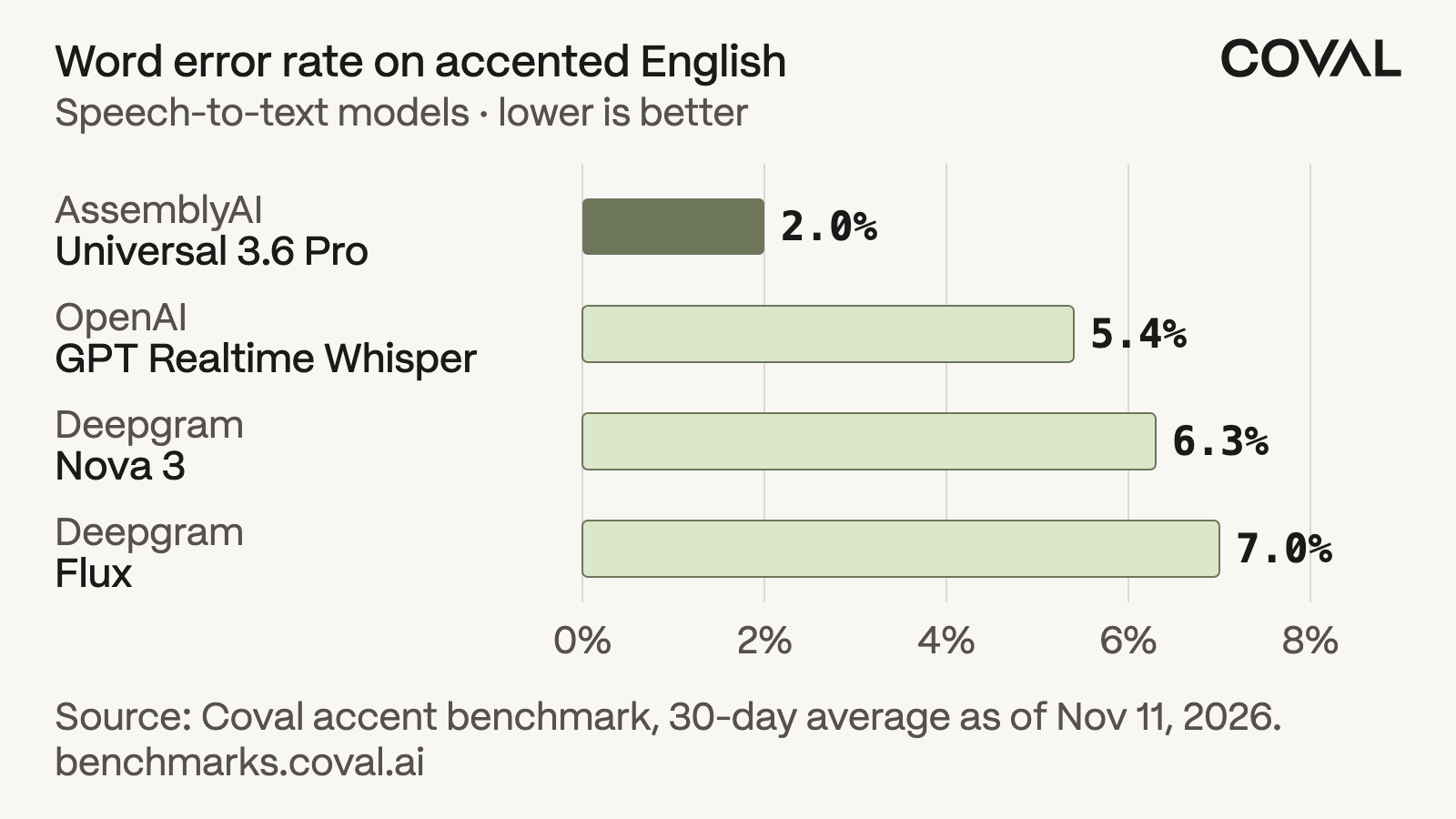
Word error rate on Coval’s accent benchmark, 30-day average as of November 11, 2026 (lower is better). The model with the most errors makes more than three times as many as the best. All four come from providers you can plug into a voice AI platform. Source: benchmarks.coval.ai.
The voice model shapes the other thing callers notice: how natural the agent sounds. Judge that the way you’d judge a new hire, on your own calls, with your callers’ tasks and your brand’s tone in mind. In Coval, an LLM judge metric has a language model grade each call against a question you write, and its audio variant listens to the recording instead of reading the transcript. A question like “did the agent sound rushed when it read back the order?” gets answered from what the caller heard, and your reviewers can confirm or override each verdict.
Price and compliance depend on what each rate covers
The per-minute prices in the table cover different slices of a call, so don’t rank them. Price the same call on each finalist instead. A five-minute call on Vapi is five minutes of hosting, plus what your transcriber, LLM, and voice providers each charge for it, plus transport. On Bland it’s five minutes at one rate for all three models, plus the phone line. On LiveKit Cloud or Pipecat Cloud it’s five agent minutes plus your model providers’ charges. Keep the call length the same everywhere, and the models too wherever you get to choose them.
BAAs follow three patterns: self-serve (Retell), a paid add-on (Vapi), or a higher plan or a request (the other four). Where the agent runs is a separate question. Bland offers on-prem or VPC deployment on its Enterprise plan, and either framework runs on your own servers, where the HIPAA work is yours. Our guide to HIPAA-compliant voice AI covers what else a healthcare agent needs.
How to compare your finalists on your own calls
Once the table has narrowed the field to two or three finalists, the way to see which one handles your callers best is to run the same calls against each and score every call the same way. That’s the vendor bake-off Coval is built to run, and here’s how we’d set it up.
- Set the weights before any demo. Write down what decides the choice for you (say, task completion, accuracy, latency, compliance, cost, and how natural the voice sounds) and give each a weight. Count a senior stakeholder’s taste in voices as one of those weighted criteria now, so it can’t overrule the results later on the strength of a single call.
- Build one test suite. It has three parts. Personas make the simulated callers sound like yours, with the voices, accents, background noise, and interruptions your real callers bring. Test sets hold what those callers are trying to do, such as moving an appointment to next week. Metrics grade every call the same way on every platform. Write the behaviors you care about as rules an LLM judge checks: the agent always verifies identity before reading account details, never quotes a price it can’t honor, and hands a distressed caller to a person. Then add an API State check, which asks your scheduling system after the call whether the appointment really moved. Latency keeps speed on the same terms for every finalist.
- Build the same agent on each finalist. Use the same prompt, tools, and test backend on every platform. Connect each one to Coval by phone number or SIP address, or directly as a LiveKit, Pipecat Cloud, or WebSocket agent.
- Run identical calls, more than once. Every finalist gets the same personas, test cases, and metrics. An agent won’t answer the same way twice, so repeated runs show you a pattern instead of one lucky or unlucky call.
- Compare by agent in one Report. A Report combines runs into one view and groups them by agent, with each metric summarized as an average, median, or p95.
- Review the calls your rules flag. Coval puts failed calls, edge cases, and calls the judge was unsure about at the top of a human review queue, so people listen to the calls that matter rather than every call.
- Decide on the weights. Expect one of four results. One finalist leads on what you weighted heaviest, and you sign. The finalists split, and your weights pick. Two are close enough that you pilot both on live traffic. Or none clears your bar, and you go back to your requirements.
Two rules keep the comparison fair. Tell vendors your criteria and categories, but keep the test cases private until the run, so no one tunes an agent to them. And score every finalist in one place: a platform’s built-in tests run on its own agents, so they can’t put two platforms on one scoreboard.
So vendor pages build the shortlist, and your own calls pick the winner. The test suite that picked it keeps working after you sign. It becomes your regression suite, rerun before every prompt or model change, and the same metrics score your production calls, so your live agent is held to the bar you set during the comparison. Because Coval is vendor-agnostic, that bar survives a later model or platform swap. The Vendor Testing Playbook puts the whole method in one place.