
Best Call Center QA Software in 2026: Picks for Human and AI Agents


The right call center QA software depends on who takes the call. Here are the picks for human agents, and why AI agents need QA that ends in a regression test.
Every call center QA program asks two questions of every call it reviews: did it meet our standard, and if it didn’t, what happens next? When a human agent skips an identity check, what happens next is coaching. When an AI voice or chat agent skips it, the fix is a change to the agent itself, plus proof that the next version gets the call right. That difference decides which call center QA software you should buy.
Quick answer: If your agents are people, the best call center QA software is usually the quality-management module in the contact-center suite you already run: NICE CXone, Genesys Cloud, or Talkdesk. If you want a QA specialist outside the suite, look at CallMiner or Scorebuddy, and add Balto if supervisors want to guide agents while they’re still on the call.
If your agents are AI, you need QA that tests each new version with simulated callers before launch, scores every real call you send once the agent is live, and keeps people reviewing the calls your rules flag, which is what we built Coval to do.
Below are the picks side by side and what each is best for. Then we look at why AI agents change the QA job, walk one scorecard item through Coval step by step, and close with the features worth checking in any demo.
| Tool | Best for | Built around |
|---|---|---|
| NICE CXone, Genesys Cloud, or Talkdesk QA | Teams already running that contact-center suite | AI auto-scoring against scorecards inside the suite your supervisors already use |
| CallMiner | QA teams choosing how much scoring to automate | Fully automated quality forms, or a hybrid with manual scoring, across channels |
| Scorebuddy | QA teams that want a dedicated QA tool | Configurable scorecards, AI scoring of voice, chat, and email, and coaching plans |
| Balto | Supervisors who want to guide agents during calls | Live answers and guidance on every call, plus automatic scoring |
| Coval | AI voice and chat agents | Simulated calls before launch, every live call you send scored, and human review of flagged calls |
What call center QA software actually does
Call center quality assurance (QA) software scores recorded calls and chats against a scorecard, sends the misses to a reviewer, and turns what the reviewer finds into coaching or a fix. The scorecard is the fixed list of questions asked of every conversation, such as “Did the agent verify the caller’s identity before discussing the account?” Contact-center suites sell the same job as quality management or quality monitoring.
By hand, a QA analyst listens to a small sample of each agent’s calls and fills in the scorecard. Software takes over the scoring: an automated scorer, usually a language model called an AI judge, answers the scorecard questions on every call you send it. That coverage is the real upgrade, because a sample can only find what lands in it.
The arithmetic is unforgiving. If a failure happens on 0.5% of calls, the chance that 20 randomly chosen calls include even one of them is 9.5%, by standard binomial math. The score a sample produces is shakier than it looks, too. Eight passes in ten calls reads as 80%, but the 95% confidence interval, the range of true pass rates that sample can’t rule out, runs from 49% to 94%.

So let software score every call, and spend reviewer hours on the calls where the score is in doubt. Listening still has its place: while call volume is low enough to hear every call, we recommend starting with manual QA.
Two products often get sold next to QA, and they do different jobs. Speech analytics looks across many calls for topics and trends, and agent assist prompts a human agent during the call. QA asks a narrower question: did this call meet the standard?
The best call center quality monitoring software for human agents
If people answer your calls, buy the contact center QA software that lives where your recordings and coaching already live. Usually, that’s the suite.
Your contact-center suite’s QA module
If you run NICE CXone, Genesys Cloud, or Talkdesk, start with its QA module. Your recordings, agents, and supervisors are already there, so a failed score turns into a coaching session without moving data between tools. NICE’s AI Quality Management promises to “Evaluate 100% of interactions with AI and deliver effective coaching to agents,” across calls, chat, email, social, and CRM tickets. Genesys Cloud lets QA programs use evaluation forms to “score up to 100% of interactions” with its Virtual Supervisor AI. Talkdesk Quality Management pairs flexible scorecards and supervisor annotations with AI that evaluates every interaction, and it plays an agent’s screen and audio recordings together.
QA specialists: CallMiner and Scorebuddy
Look outside the suite when your QA team wants more control over how scoring works. CallMiner lets you choose “fully automated quality forms that scale, or combine with manual scoring for a customized, hybrid approach,” and it analyzes interactions from every channel. Scorebuddy, which describes itself as “built by QA experts,” centers on scorecards configured to your standards, AI scoring across voice, chat, and email, and coaching plans built on the results.
Live guidance: Balto
Balto is agent assist with QA built in, so it’s the pick when supervisors want to help agents during the call, not only after it. It gives agents “real-time answers and guidance on every call” and auto-scores every interaction too.
All of these are built around coaching people. A score lands with a supervisor, the supervisor talks it through with the agent, and the agent handles the next call better. When the agent is software, the fix looks different.
Why AI agents need a different kind of QA
An AI agent isn’t a person having a bad day. It’s a version: a prompt, a model, and a set of tools that every call shares. If that version skips the identity check on one call, it can skip it on every call that goes the same way, until someone changes the version. Coaching won’t reach it. The fix is a new version, and the only proof the fix works is a test.
The version can also change when nobody ships anything. Hosted models get updated behind the same name: Stanford and UC Berkeley researchers found that GPT-4’s accuracy at identifying prime numbers fell from 84% in March 2023 to 51% in June 2023. As we wrote in our regression testing guide, “Vendor model updates don’t always change the version string.” An agent that passed its tests last month can fail them today.
That’s why scoring finished calls is the smaller half of QA for an AI agent: it tells you what callers already heard. The bigger half is the regression test, a saved test call that runs against every new version to check that a behavior which used to pass still passes. Run those tests before each launch and on a schedule, and you hear about a broken identity check from a test instead of a customer.
Coval: the best QA software for AI voice and chat agents
Coval is purpose-built for that job, and for teams in regulated industries where a skipped check is a compliance problem rather than a coaching note. It runs the whole job as one loop: simulation before launch, monitoring on every live call you send, and human review, where your QA team checks the AI judge’s verdicts on the calls your rules flag. A confirmed failure from a live call can become the next test.
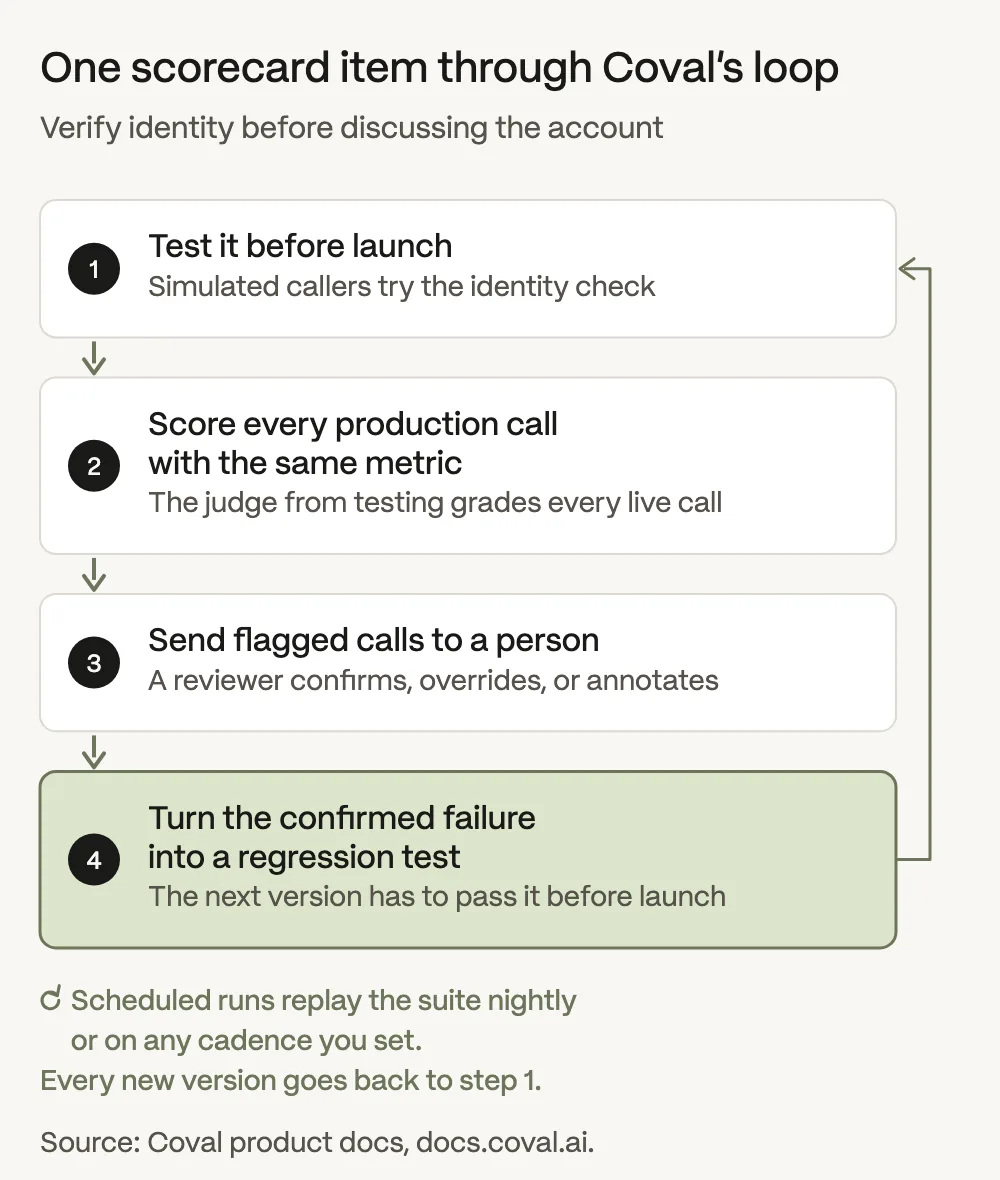
Here’s one scorecard item moving through that loop. Say you run an account-services voice agent, and the item that matters most is verifying identity before discussing the account.
-
Test it before launch. In a simulation, Coval “plays the role of a realistic user, talks to your agent end to end, and evaluates the conversation against criteria you define.” Personas set how each simulated caller sounds and behaves, down to accents, interruptions, and background noise. A test set says what the caller is trying to do: here, ask for a balance before anyone has checked who they are. The scorecard item becomes an LLM judge metric with the question “Did the assistant verify identity before discussing the account?” By default, Coval’s proprietary judge answers it.
-
Score every production call with the same metric. Once the agent is live, you send its real calls to Coval through the API, SDK, or an integration, and every production call gets scored against the same metrics you tested with. The same judge that passed the agent in simulation is the one grading live calls, and with no sample, a failure on 0.5% of calls has nowhere to hide.
-
Send flagged calls to a person. Smart sampling uses rules you set to put failures, edge cases, and calls the judge wasn’t sure about at the top of the review queue, so your analysts hear the calls that matter instead of a random sample. In Human Review, a no-code screen built for QA analysts, compliance reviewers, and ops teams, they confirm, override, or annotate the AI judge’s verdicts inline. Every override, annotation, and verdict is tracked, so compliance teams get the trail they need. That’s how a QA team moves from manual QA to AI-assisted QA without giving up control of its quality bar.
Reviewers also keep the judge honest. In a calibration we published, we compared an outbound voice agent’s AI-disclosure judge (did the agent say it was an AI?) with human reviewers on the same 314 conversations, and the two agreed on 89% of them. That agent was built to confirm it had the right person before saying it was an AI. Reading the 35 disagreements showed one pattern: “In every disputed call, a wrong party picked up or the caller hung up early.” Those calls ended before the agent reached the disclosure step, so the agent was right not to disclose, but the judge failed those calls anyway. The fix was one paragraph added to the judge’s prompt: if the caller is a wrong party or the call ends before identity verification, the agent may never reach the disclosure stage, so count the call as a pass. The calls the judge had been failing came back as passes, matching the human labels, with no change to the model or the agent.
-
Turn the confirmed failure into a regression test. Once a reviewer confirms the agent really skipped the check, that call becomes a test case the next version has to pass before launch. Scheduled runs then replay the whole regression suite nightly or on any cadence you set, which is how you catch the model update nobody shipped.
Teams already use Coval for this. Zoom’s QA team runs daily scheduled regression tests. Krew, which builds voice agents for credit servicing, went from basic QA to comprehensive testing in 60 days, and its rule is simple: “Whenever there’s an edge case, we add it into our eval set.”
Coval supports voice and chat agents on one platform, whether you built the agent in-house or bought it from a vendor. It’s SOC 2 Type II and HIPAA compliant, with single-tenant deployments available.
Key features to look for in call center QA software
Whichever tool you pick, a QA score is only as good as the question behind it and the people checking it. Test these five in any demo.
- One observable yes/no question per behavior. “Did the agent show empathy?” leaves the judge, human or AI, to decide what empathy means. Our judge-prompt guide sets two rules: “Use concrete, measurable behaviors instead of abstract concepts” and “One metric should measure one thing.” Then keep the answer yes or no rather than a 1-to-5 rating, because, as ML consultant Hamel Husain puts it, “People don’t know what to do with a 3 or 4.”
- Critical items scored on their own. A weighted total can bury a missed identity check inside a passing score. NICE’s auto-scoring, for example, “calculates the final Scorecard result using a weighted average,” and it lets admins “Define critical questions that must be answered correctly for a successful evaluation.” Ask every vendor how a critical miss shows up.
- Calibration that reports catch rate, not just agreement. Calibration checks that your reviewers and your AI judge give the same answer on the same calls. Even expert reviewers don’t always agree with each other: when Observe.AI researchers (Observe.AI sells contact-center QA software) had seven QA experts answer 50 yes/no scorecard questions on 100 calls, at least five of the seven agreed on only 3,061 of the 5,000 answers, about 61%, so settle your reviewers’ answers first. Percent agreement can also flatter a lazy judge. In an example from our review docs, reviewers fail 5 of 100 calls, and a yes/no metric that passes all 100 “has 95% agreement” while catching none of the five. So ask for catch rate, the share of reviewer-flagged failures the judge also caught, and chance-corrected agreement, which strips out the agreement you’d expect by chance given how often each answer comes up.
- Audio checks for voice. A text transcript loses how the call sounded, like the agent talking over the caller or a long silence, and voice agent QA has to judge timing, turn-taking, interruptions, and audio issues, not just the words. That’s why Coval’s AI judges come in audio variants that evaluate the recording directly.
- For AI agents, a path from a failed call to a regression test. Simulated tests before launch, the same metrics on production calls, and a way to save a confirmed failure as a test the next version must pass. Ask to see one failed call go all the way through.
Pick QA software by what happens after a failed call
If people answer your calls, the best call center QA software is the QA module in the suite you already run, or a specialist like CallMiner or Scorebuddy when your QA team wants more control. A failed call ends in coaching, and those tools are built for it. If AI agents answer your calls, a failed call has to end in a regression test, with people checking the judge along the way. That’s the loop Coval runs.
The quickest way to see it is with your own material. Bring your most important scorecard item and one call that failed it to a Coval demo, and we’ll walk it through simulation, production scoring, review, and a regression test.
Frequently asked questions
How much does call center QA software cost?
Scorebuddy’s pricing lists its Foundation, Accelerate, and Elite plans with “Request a price.” Coval publishes its prices. As of November 2026, Starter is $100 a month with 3,000 minutes of live-call scoring and 100 simulation minutes, Growth is $500 a month with 30,000 minutes of live-call scoring and 1,000 simulation minutes, and Enterprise, for regulated industries and high-volume teams, starts at $4,500 a month. Starter and Growth include a 7-day free trial.
Can AI scoring replace human QA reviewers?
No. People decide what the standard is, settle the calls where it’s unclear, and check that the AI judge still agrees with them after a prompt or model change. What AI scoring changes is which calls they hear: instead of a random sample, reviewers get the failures and the calls the judge wasn’t sure about. Their time goes further, and their corrections are what keep the judge accurate.