
Coval vs Sierra in 2026: Why AI Agents Need Independent Testing


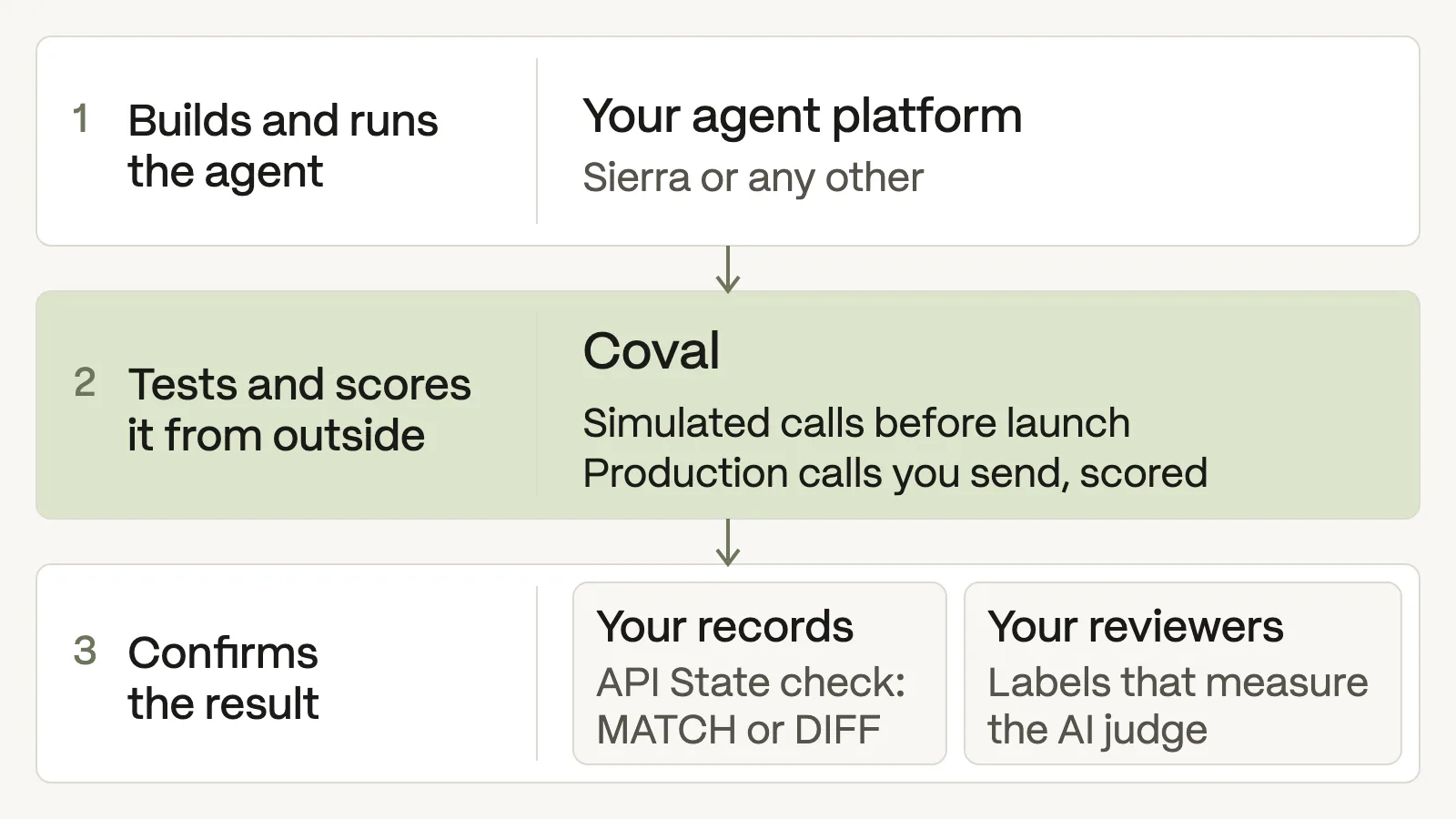
Sierra builds and runs the agent and tests it with its own simulations. Coval is the independent evaluation layer that checks it from outside, confirms the action was completed correctly, and measures its scores against your reviewers.
If your customer-service agent runs on Sierra, or soon will, it comes with testing built in: simulated customers, an AI judge (a language model that grades each conversation), and monitors on live traffic. So the question for your QA and risk teams is less about which product builds the agent and more about who should check it: the company that built it, or an independent third party.
Our answer to the Coval vs Sierra question is that a Sierra agent still needs Coval. Sierra builds and runs the agent. Coval is an independent evaluation layer: it tests voice agents before launch and scores live conversations from agents on any platform, Sierra included. That independence is the whole point. A builder has little reason to go looking for flaws in its own work, which is why you wouldn’t have the author of a paper grade it. When one vendor builds the agent, writes its tests, and grades the results, the checks start from the same assumptions as the agent, so they can share its blind spots.
Below, we weigh what independence buys you: the failures a builder’s own tests can miss, evidence your auditors and enterprise buyers will accept, proof that the task actually happened, scores checked against your own reviewers, and one record across every platform you run. Here’s how we see the two side by side.
| Criterion | Coval | Sierra |
|---|---|---|
| Role | Independent evaluation layer: tests and monitors agents | Agent platform: builds and runs the agent |
| Works with agents on any platform | Yes: vendor-agnostic, so it works with whatever’s in your stack, including Sierra | No: its evaluation only covers agents built on Sierra |
| Independent of the vendor that built the agent | Yes: Coval doesn’t build or run your agent | No: the same vendor builds the agent, its tests, and its judge |
| Confirms the action was completed correctly | Yes: after a test call, it checks your order or account records to confirm the refund or account change actually went through | Not publicly documented |
| Human review queues for ground truth | Yes: your reviewers label the calls your rules flag, and Coval measures its AI judge against them | Not publicly documented |
Coval vs Sierra: one builds your agent, the other checks it
Sierra is a platform for building and running customer-service AI agents, and it now features testing as part of its platform. Its simulations pit each agent against simulated users and have an AI judge grade the conversations. Its monitors use an AI judge to review every live conversation.
Coval does a different job. It’s an evaluation platform for voice and chat agents that sits on top of whatever you’ve built, and it works as one loop. Simulation tests the agent before launch, with Coval playing a realistic customer who talks to it end to end with things like background noise and accents. Monitoring scores your real production conversations with Coval’s own AI judge, against metrics you set. Human review brings people in to label specific calls, which checks and corrects that judge. What monitoring and your reviewers find in live calls becomes the next test. Coval doesn’t build or run your agent, so every part of that loop sits outside it.
A vendor that grades its own agent shares its blind spots
Sierra’s testing is real testing. So what does an outside layer add? The answer starts with where the tests come from. When you create an agent, Sierra generates its test cases automatically from your standard operating procedures, knowledge bases, coaching transcripts, and conversation flows: the same material the agent is built to follow. Then Sierra’s AI judge grades the results.
Here’s where that goes wrong. Say your refund policy allows returns within 30 days. Your finance team counts those days from delivery, but the agent was built to count from the order date. Tests generated from that same policy, by the same platform that built the agent, can easily read it the same way, and a judge grading against that reading passes the agent on every run. Every check did its job. The checks simply came from the same place as the mistake.
Sierra describes its grader as an independent judge, and it is independent of the agent it grades. It isn’t independent of the vendor that built the agent and generated the tests. If Sierra’s own checks are the only ones you run, every release and every live call is tested and scored by the company that built the agent.
NIST, the US standards agency, makes the same point in its voluntary AI Risk Management Framework. It calls for regular assessments by “internal experts who did not serve as front-line developers for the system and/or independent assessors.”
Coval is that independent assessor. It has no stake in which platform’s agent passes, and your team decides what passing means: you choose from Coval’s library of metrics or write your own. In the refund case, your team writes the test the way finance reads the policy, counting 30 days from delivery, and the agent that counts from the order date fails it.
Independent results hold up with auditors and enterprise buyers
Your own team isn’t the only audience for these results. Auditors, risk teams, and the enterprise customers who buy from you all want evidence that the agent behaves, and in our view, where that evidence comes from matters as much as the scores. Auditors discount a vendor grading its own product. A third party with no stake in the outcome gives a stronger record.
Krew builds voice agents for credit servicing. It added Coval as an independent check, and in 60 days went from basic QA to comprehensive, third-party validated testing.
That record also pays off outside engineering. When banks put Krew through third-party risk management, the review a bank runs before it relies on an outside supplier, Krew can show active compliance monitoring through an independent platform. Krew’s reports travel to customers, too. “It’s a great report I can print out and send to customers,” as Mike from Krew put it.
Coval confirms the task actually happened
A record that auditors trust still has to check the right thing, and a transcript only tells you what the agent said. Stay with that refund policy. A caller asks for a refund, the agent approves it, says the money will arrive in five to seven days, and ends the call politely. The transcript reads perfectly, and a judge reading it would pass the call. Whether the refund was actually issued is a question for your order system.
So Coval asks your system. After a simulated call, the API State metric calls an endpoint you configure, reads the value at the spot in the response you point it to, such as the order’s refund status, and compares it with the value you expect. MATCH means your system shows what should have happened. DIFF means it doesn’t, which points to an action the agent failed to take or got wrong. It’s a rule-based check with no language model involved, so there’s no judgment call in the result.
That’s how Coval verifies that the agent completed the correct action, and didn’t just make it to a polite goodbye.
Human review turns automated scores into evidence
The backend check covers actions. Much of what a regulated team has to prove, like whether the agent disclosed that it’s an AI or explained a fee the way your policy states it, lives in the conversation, and an AI judge scores it. That judge needs checking too, against ground truth: the answer a trained person gives about the same call. In Coval, your reviewers supply it.
The work happens in a review project, which groups the conversations to review, the metrics to label, and the people assigned to the work. Nobody has to hand-pick calls. Auto-add rules pull in new conversations whose scores match a condition you set, such as every call the judge failed on refund eligibility. Reviewers answer the same yes-or-no question each metric asks, such as whether the agent disclosed that it’s an AI, and Coval compares their answers with the judge’s.
The obvious measure, how often the two agree, can hide a useless metric. If your reviewers pass 95 of 100 calls, a metric that passes all 100 agrees with them 95% of the time and still catches none of the five failures. That’s why Coval’s review insights show catch rate, the share of reviewer-flagged problems the metric also caught, alongside agreement for each yes-or-no metric.
Disagreements can also show that the metric is the problem. In a calibration case we published, a team running an outbound voice agent checked whether the agent disclosed that it’s an AI. The judge agreed with reviewers on 89% of 314 conversations, with 35 disagreements. In every disputed call, a wrong party had picked up or the caller had hung up early, before the agent reached the disclosure. The agent wasn’t broken. The metric was, and one paragraph added to the judge’s prompt fixed it.
Your reviewers’ work feeds back into the system. Every override and annotation they make retrains the AI judge, and Coval tracks every override, annotation, and verdict, so when an auditor asks who decided a call passed, your compliance team can show them. If you don’t have reviewers to spare, Coval offers labeling as a service: trained reviewers who label your conversations and calibrate your metrics for you.
Coval works across platforms, and stays if you switch
Coval can test a voice agent the same way your customers reach it, by calling it: its simulated caller dials the agent’s phone number, or its SIP address if the agent takes SIP calls. For production, you upload calls and chats to Coval through the API, CLI, or SDK, and Coval scores them with the same metrics it uses in simulation. Send every call and chat, and every one gets an independent score against your own metrics.
Because Coval sits outside the platform, it works across platforms too. Our production monitoring evaluates agents on Sierra, Decagon, Parloa, in-house builds, or a mix of them. Run more than one platform, and they all meet one bar. Move to a different platform later, and Coval stays: your test history, metrics, and ground truth carry over. If you’re comparing platforms now, a vendor bakeoff runs the exact same calls against each one.
Sending production calls to a third party is a fair concern for a regulated team. Coval is SOC 2 Type II and HIPAA compliant, with single-tenant deployments available.
Start with your agent’s phone number
So who should check your agent? Someone with no part in building it, your own records, and your own reviewers. The fastest way to see that on your own agent is our free audit: give us your agent’s phone number, and we’ll run 30+ simulations against every behavior you select, in two business days.
To run the tests yourself, as of October 2026 Coval’s plans start at $100 a month for Starter and $500 a month for Growth, each with a 7-day free trial. Enterprise starts at $4,500 a month and is built for regulated industries, high-volume teams, and multi-team organizations. If your risk team wants to see the backend checks and the review trail first, request a demo and we’ll walk through both on your use case.