
Coval vs Datadog in 2026: What Your LLM Traces Don't Hear


Datadog traces your agent's LLM calls. Coval scores the conversation itself, from the audio and transcription to timing and policy, before launch and on every production call you send.
If your voice or chat agent already reports to Datadog, you can see every LLM call, tool call, token, and slow response, tied back to the services behind them. So what would Coval show you that Datadog doesn’t?
The short answer: Datadog watches your application, and Coval watches the conversation. Datadog’s LLM Observability, now called Agent Observability, works on text and application data. Coval scores each voice call and chat on what actually happened to the customer: whether their words were transcribed correctly, whether the agent talked over them, and whether it followed your policies. Keep your application and LLM traces in Datadog, and add Coval to test your agent with simulated callers before launch and score every production conversation you send it. Below, we compare Coval and Datadog, starting with what each one watches in production.
Coval vs Datadog at a glance
Here’s how the two compare, based on Coval’s product pages and docs and on Datadog’s Agent Observability product page and docs (October 2026).
| Criterion | Coval | Datadog Agent Observability | Verdict |
|---|---|---|---|
| Production conversations | Every voice call and chat you send, scored against your metrics, with real-time flags | LLM calls, tool calls, and agent steps in the apps you instrument (text and application layer only) | Coval: scores every conversation |
| Audio | Transcription accuracy, word error rate, background noise, interruptions, response gaps, and audio sentiment | Text only | Coval: hears the call |
| Testing before launch | Simulated callers talk to your agent end to end, with accents and background noise | Experiments compare prompts, models, and configurations on datasets | Coval: tests the whole call |
| Agents from many vendors | Vendor-agnostic: voice and chat agents on whatever’s in your stack, including Sierra, Decagon, and Parloa | The applications you instrument with its SDK or API | Coval: one view of every agent |
| Human review | QA and compliance reviewers listen to the calls your rules flag, and agreement with the LLM judge is tracked | Annotation queues for LLM traces (text) | Coval: scores QA can defend |
Coval scores every production conversation against your metrics
Once your agent is live, you send each production voice call and chat to Coval through its API, SDK, or an integration. Coval’s monitoring scores every one against the metrics you choose: did the agent verify the caller’s identity, disclose that it’s an AI, and resolve the issue? The usual way to check conversations is a QA team listening to a small sample of calls. With Coval, there’s no more sampling: every call you send gets scored.
Datadog’s Agent Observability follows each request through your agent’s prompts, retrieval steps, tool calls, and decisions, and tracks latency, token usage, and errors at every step. So it will trace the LLM calls inside a voice agent, as text and application data, but it doesn’t watch the conversation itself for quality and compliance problems as they happen.
Coval does. As calls come in, it flags compliance breaches and drops in your agent’s scores. It also learns what normal looks like for your agent, so it notices when quality starts to drift, and you can set threshold alerts without configuring any separate tooling.
A score is only as good as what it can see, though. On a voice call, much of what the caller experienced never reaches the text.
Coval listens to the call itself
Coval measures the audio and timing of every voice call it scores, along with how accurately the call was transcribed, so it catches failures that look perfectly healthy as text. The clearest case is a transcription error.
Say a caller on a noisy line reads out an account number ending in 4519, and speech-to-text (STT), the model that turns the caller’s voice into text, writes 4515. The LLM receives clean, confident text, looks up the account ending in 4515, and answers politely about the wrong account. In a text trace like the one Datadog records, every step looks fine: the transcript arrived, the LLM call was fast and well formed, and the account lookup succeeded. The call still failed. As our guide to word error rate puts it, when the transcript is wrong, “every downstream step runs on bad data.”
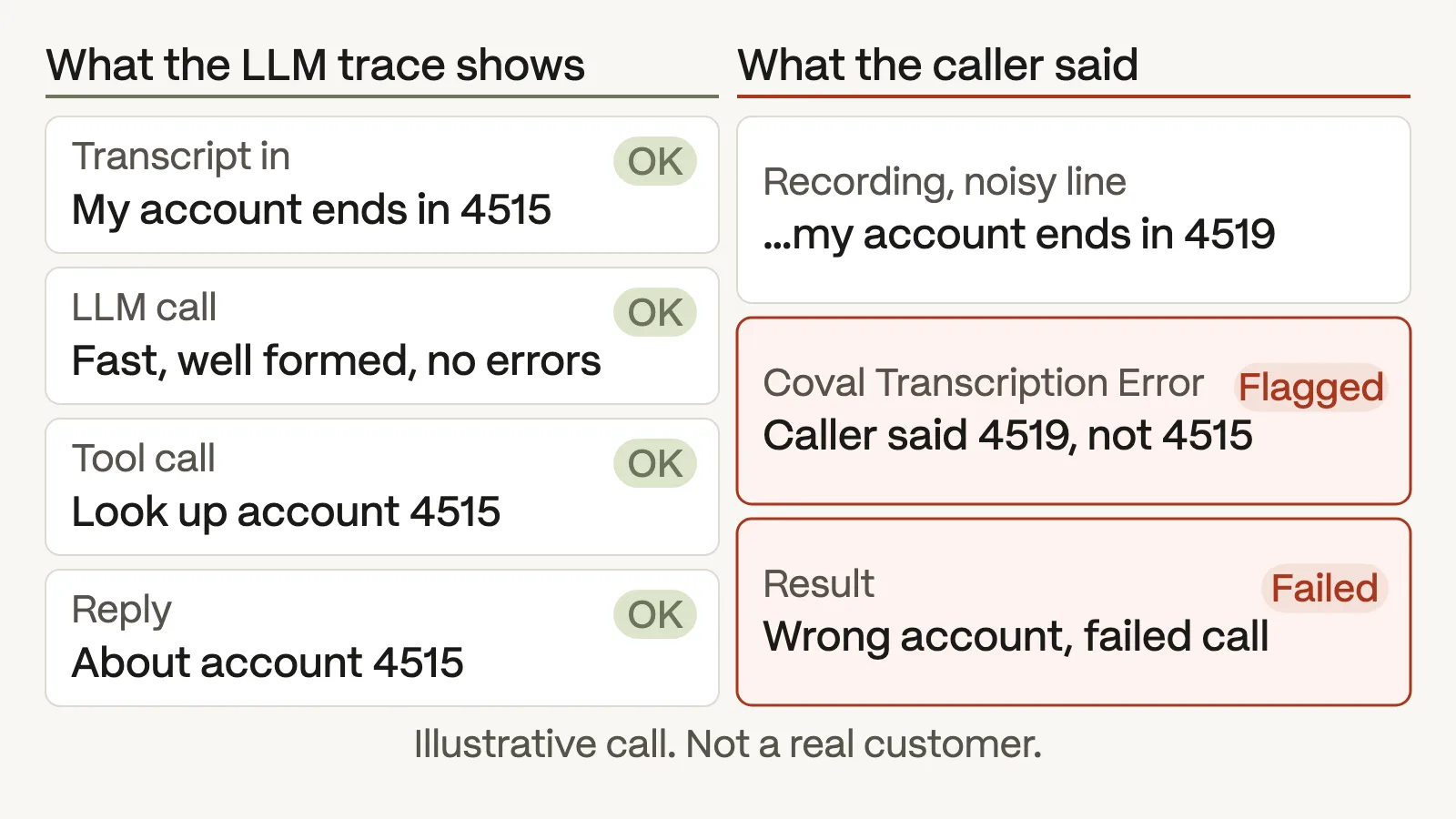
Coval checks the step a text trace takes on faith. It generates an independent reference transcript from the call audio and compares it with the call’s transcript, so the misheard 4515 shows up as a transcription error. STT Word Error Rate compares your agent’s speech-to-text output with Coval’s own reference transcript and gives the share of words it got wrong. Other metrics read the recording itself. Background Noise reports the line’s signal-to-noise ratio (higher is cleaner), Interruption Rate counts how often per minute the agent talks over the caller, and Latency measures the silence between the caller finishing and the agent starting to answer.
Two more catch what a transcript drops entirely. Audio Sentiment reads the emotional tone of each stretch of speech from the voice, not the words. And Coval’s LLM judge, a language model that scores a conversation against a question you write (“Did the agent confirm the account before sharing the balance?”), has audio variants that evaluate the recording directly instead of the transcript.
Coval tests the whole call before a customer hears it
The better place to catch that misheard account number is a test call, and that’s what Coval’s simulations are for. In Coval’s own words, it “plays the role of a realistic user, talks to your agent end to end, and evaluates the conversation against criteria you define.” Datadog’s experiments compare prompts, models, and configurations on the same dataset, which tests the LLM layer of your agent. A Coval simulation runs the whole conversation, from the caller’s first word to the agent’s last.
Each simulated caller is a persona you configure: its voice, its language and regional accent, background noise from a built-in library or your own recordings, and how often it interrupts. Pair personas with the scenarios that matter to your business (a bill payment, an address change, a caller who won’t verify their identity), and Coval scores every test call. Every metric works on both simulated conversations and live production calls, so the check you trust in testing is the same one watching production.
Testing also keeps pace with your releases. Coval’s GitHub Actions integration is built to “stress-test every pull request automatically,” and scheduled runs can cover a nightly regression suite or a weekly model comparison. When you need to know how the agent holds up under production-scale traffic, load tests run up to 1,000 concurrent simulated calls.
One view across every agent, voice and chat, whoever built it
The agent that misheard 4519 may not be your only one, and it may not be one your team built. Coval is vendor-agnostic by design: it works with whatever’s in your stack, including Sierra, Decagon, and Parloa. It scores all of those agents with the same metrics, voice and chat alike, on one platform. A company running a voice agent from one vendor and a chat agent from another gets one place to see whether every agent is doing its job, and one standard to compare them on.
Datadog’s Agent Observability traces the applications your team instruments with its SDK for Python, Node.js, or Java, or with its HTTP API. Coval scores the conversation, whatever code produced it. Each call or chat reaches Coval as an uploaded conversation: its transcript, with the recording when you have it.
Seeing every agent in one place raises the stakes on the scores themselves. If compliance is going to act on them, someone has to stand behind them.
Human review makes Coval’s scores defensible in regulated industries
Coval is focused on regulated industries, where a score is only useful if QA or compliance can defend it. That’s why human review sits at the core of the platform: people check the LLM judge’s verdicts on the calls your rules flag, and every override and annotation retrains the judge.
Review is built for QA analysts, compliance reviewers, and ops teams, with no code required. Reviewers confirm, override, or annotate the judge’s verdicts inline, and they listen to the recording whenever a judgment depends on timing, tone, or an interruption. On the misheard-digit call, the recording is where a reviewer hears the digit the transcript got wrong. Blind Review hides the judge’s score while they label, so the automated answer doesn’t sway them. Datadog’s annotation queues give people a way to review LLM traces; Coval gives them the call.
Coval then compares the human answers with the judge’s. Agreement alone can mislead: if 5 of 100 calls failed and the judge marks all 100 as passing, it has 95% agreement with reviewers and catches none of the five failures. So Coval also shows whether the judge catches the failures that matter.
The disagreements are where the work is. A team running an outbound voice agent checked whether the agent told callers it was an AI, and the judge reached 89% agreement with human reviewers across 314 conversations, with 35 disagreements to work through. Teams without their own reviewers don’t need to hire them first: Coval offers labeling as a service, with trained human reviewers who label your conversations and calibrate your metrics for you.
All of it stays on the record. Every override, annotation, and verdict is tracked, so compliance has the audit trail it needs. The platform itself is SOC 2 Type II and HIPAA compliant, with single-tenant deployments available.
Coval works alongside the Datadog setup you already have
You don’t have to pick one. Keep your application and infrastructure monitoring, your LLM call traces, and your token costs in Datadog, where your engineers already look. Add Coval to know whether your voice calls and chats went right, from simulated callers before launch to every production conversation you send it after launch. The two sit in the same stack: Coval is OpenTelemetry-native and integrates with Langfuse, LangSmith, Arize, and Datadog.
Go back to the caller whose account ends in 4519. Datadog shows you a request that ran fast and clean. Coval shows you a caller who got the wrong account. If you’re still mapping out what to watch on a live voice agent, our guide to voice AI observability is a good place to start.
As of October 2026, Coval’s plans start at $100/month for Starter and $500/month for Growth, both with a 7-day free trial. Enterprise, built for regulated industries, high-volume teams, and multi-team organizations, starts at $4,500/month. Every plan includes the full platform: simulation, monitoring, and human review. If you’d rather see results on your own agent first, give us its phone number, and our free audit runs 30+ simulations against every behavior you select, with results in two business days.