
Coval vs Cyara in 2026: Which Platform Is Best for Voice AI Agents?


Cyara retrofitted a scripted-IVR testing platform to AI agents. Coval was purpose-built for them, with simulated callers that sound real, checks that confirm each action was completed correctly, and human review at the core.
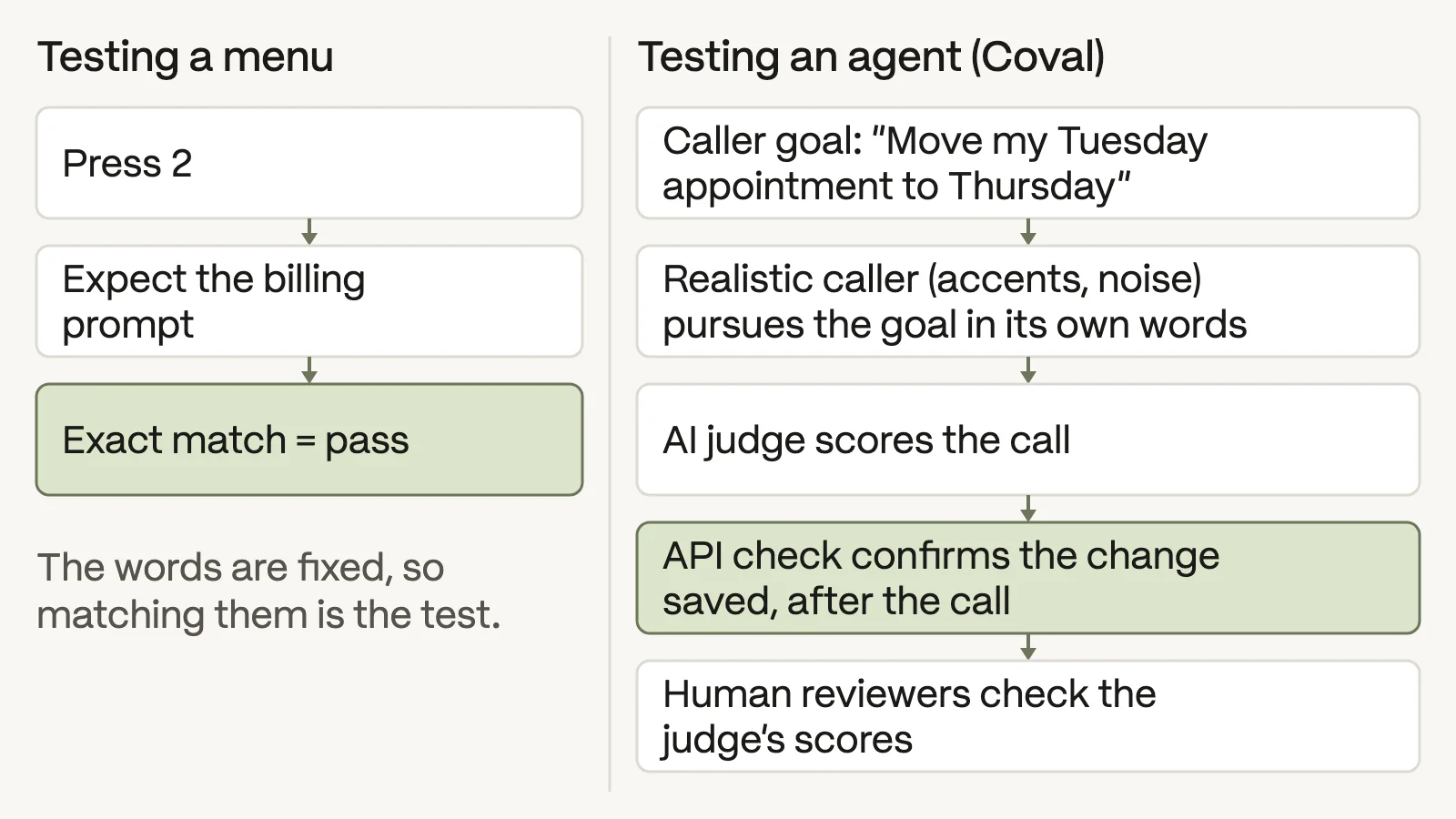
A test for an IVR menu is simple to write: press 2, expect the billing prompt, fail if anything else plays. An AI agent breaks that model. It can answer the same request in different words on every call, so there’s no expected prompt to check against. If your contact center is replacing menus with an AI voice or chat agent, that’s the real test when you compare Coval vs Cyara: which platform was built for agents that don’t follow a script?
For AI agents, Coval is the better choice, because it was purpose-built for them rather than retrofitted. Cyara has tested scripted IVR flows for more than 20 years, and chatbots through its Botium product, and launched agentic testing for AI agents across voice and digital channels in March 2026. Coval has been testing voice and chat AI agents since 2024. Coval simulates callers with realistic accents and background noise, checks your own systems to confirm the booking or account change actually happened, and keeps human reviewers at the center, so your scores hold up in an audit.
Both are SOC 2 Type II and HIPAA compliant, so compliance won’t decide this. Whether you’re weighing the two head to head or shopping for a Cyara alternative, five other things will help you decide: which was built to test an agent with no script, whether it confirms the task got done, whether its scores hold up under audit, how it fits the way your engineers ship, and how you buy it.
Here’s how the two compare, based on each company’s public product information as of October 2026. Each row has its own section below.
| Criterion | Coval | Cyara | Verdict |
|---|---|---|---|
| Built for | AI voice and chat agents, from the start | Scripted IVR testing for 20+ years, chatbot testing via Botium; agentic AI testing added March 2026 | Coval: built for AI agents |
| Confirming the task got done | Checks your backend after the call to confirm the booking or change saved | Not publicly documented | Coval: verifies the outcome |
| Human review | Review queues on every plan; your reviewers or ours check the AI judge on the calls your rules flag | Not publicly documented | Coval: scores you can defend |
| Engineering workflow | CLI, API, MCP server, agent skills, GitHub Actions | Portal-centric, REST API for automation | Coval: runs where engineers ship |
| Buying and getting started | Published plans from $100/month, 7-day free trial, full platform on every plan | No published pricing; starts with a demo request | Coval: priced in public |
Coval was built for agents that don’t follow a script
You can’t predict what an agent will say, but you can decide what the caller wants. Our IVR testing guide puts it in one line: define test scenarios as goals, not scripts.
That’s where a Coval test starts. Each test case gives the simulated caller an objective for the run, like moving a Tuesday appointment to Thursday. The caller pursues that goal in its own words, the way a real customer would, so the agent faces a different conversation each time.
A persona decides who is calling: the simulated caller’s voice, accent, language, audio environment, and conversational behavior. Coval mixes background noise into the caller’s side of the call, and an interruption setting controls how often the caller cuts the agent off, the way real callers do.
Then an AI judge scores the call. It’s a language model that answers a question you write about the conversation, such as “Did the agent confirm the new appointment time?” Each of those questions is one kind of metric. For voice agents, audio versions of the judge evaluate the recording itself rather than the transcript.
We test agents this way because it’s how self-driving cars are tested. Before starting Coval, our founder Brooke Hopkins led the evaluation job infrastructure team at Waymo. A self-driving car is essentially an agent on wheels, and nobody can script every road it will meet. Coval’s engine is built on the same principles: simulation at scale, personas designed to probe failure modes, and stress tests before launch.
Cyara launched agentic testing for AI agents on March 31, 2026, after more than 20 years of scripted IVR tests like the one at the top of this post: press 2, expect the billing prompt. Coval was built for AI agents from the start, and a Coval test starts from the caller’s goal.
Coval confirms the task actually happened in your systems
A caller asks to move a Tuesday appointment to Thursday. The agent confirms the new time, thanks them, and ends the call, and the transcript reads perfectly. Whether the appointment actually moved is a question for your scheduling system, not the transcript.
So Coval asks your system. The API State metric runs after the simulated call: Coval calls an endpoint you configure, reads the value you point it to in the response, and compares it with the value you expect. The result is a match, a difference, or a value not found. No language model is involved, so there’s nothing to interpret. Cyara doesn’t publicly document an equivalent check on your backend.
This check lets Coval test a multi-step workflow end to end: book an appointment, confirm it persisted, reschedule, verify again. Chime uses these checks to confirm card status, account freezes, and other account changes after a test call. For a regulated business, that’s the difference between an agent that sounded helpful and one that did the work.
Human review keeps Coval’s scores defensible in an audit
Some of what a regulated contact center has to prove never lands in a database. Did the agent disclose that it’s an AI? Did it verify the caller’s identity before reading out a balance? An AI judge can answer those questions on every call, but sooner or later someone in compliance will ask how you know its answers are right. Coval’s answer is people: your reviewers, or ours, check the judge.
That work happens in a review project: a queue that holds the calls to review, the metrics to label, and the people assigned to the work. Nobody has to hand-pick calls. You set a rule, such as every call where the disclosure check failed, and matching calls join the queue as they come in. Coval also moves the calls where the judge is least certain to the top, so reviewers aren’t wading through a random sample. Each reviewer sees the judge’s verdict on the call and confirms it, overrides it, or adds a note, without writing any code.
Their labels tell you how far to trust the judge, and the obvious number, how often the judge agrees with them, can fool you. Say your reviewers pass 95 of 100 calls and fail 5. A judge that passes all 100 agrees with them 95% of the time and catches none of the five failures. So for each yes-or-no metric, Coval’s review insights report catch rate next to agreement. Catch rate is the share of the problems your reviewers flagged that the judge also caught. In that example, it’s zero.
Disagreements can also expose a bad metric. In one published case, a team running an outbound voice agent checked whether the agent disclosed that it was an AI and found 89% agreement across 314 reviewed conversations, with 35 disagreements. Reading those 35 showed the agent wasn’t broken. The metric was. In every disputed call, a wrong party had picked up or the caller had hung up early, so the agent never reached the point of disclosing anything. One paragraph added to the judge’s prompt fixed it, and the calls the judge had been failing came back as passes that matched the reviewers.
Every verdict, override, and note is tracked, so compliance has the trail it needs when an auditor asks. If you don’t have reviewers to spare, Coval offers labeling as a service: our trained reviewers label your conversations and calibrate your metrics for you. Cyara doesn’t publicly document human review queues.
Review queues come with every Coval plan, and review doesn’t stop at launch. Coval scores your production calls with the same metrics, so a failure your reviewers catch on a live call becomes the next test you simulate. Simulation, monitoring, and human review work as one loop.
Coval runs where your engineers already ship
An agent changes every time someone edits a prompt, swaps a model, or adds a tool. When those changes ship through pull requests like any other code, the pull request is the moment to catch a regression, before a caller finds it.
Coval is CLI and API first, so engineers run evaluations from the terminal, the CI pipeline, or the agent’s own code. Going from install to a first simulation takes under 15 minutes with the Coval CLI, and the GitHub Actions integration stress-tests every pull request automatically. Cyara starts somewhere else: its platform is portal-centric, with a REST API for automation.
Teams that build with AI assistants can stay in them. Our MCP server lets you use Coval from ChatGPT, Claude, and Codex, and our agent skills teach coding agents such as Claude Code and Cursor how to run evaluations well.
Not every check has to wait for a pull request, either: at Zoom, a Coval customer, the QA team runs daily scheduled regression tests.
Coval vs Cyara pricing: only Coval publishes its plans
You should be able to price a testing platform before your first sales call. As of October 2026, Coval’s plans are Starter at $100 a month, Growth at $500 a month, and Enterprise from $4,500 a month. Each plan covers simulation, monitoring of your production calls, and human review. Enterprise is the plan for regulated industries, high-volume teams, and multi-team organizations, and it adds private or VPC deployment.
Cyara’s site doesn’t publish prices, and buying starts with a demo request. Its AI agent capabilities are also spread across several products, while every Coval plan includes the full platform. Coval’s Starter and Growth plans begin with a 7-day free trial, and if you’d rather see results before setting anything up, our team will run a free audit of your agent.
See the difference on your own agent
The menu test at the top of this post checked one thing: did the right prompt play? On your own agent, check what matters now. Did the caller reach the goal, did the change land in your systems, and would your reviewers sign off on the score?
The quickest way to find out is the free audit. Give us your agent’s phone number, and we’ll run 30+ simulations against the behaviors you want checked, within two business days. To run the tests yourself, start the 7-day trial, or request a demo and walk through it with our team. You don’t have to start from scratch: upload the test cases you already have from a CSV or Excel file. If you’re still moving callers off menus, our IVR migration guide covers the path.